Cryptocurrencies have matured from being zones for the average investor seeking to make a quick buck: They are often being used for real-world applications, with music representing one of the great affected sectors of blockchain innovation. From payouts to artists and rights management to fan engagement and ticket-based applications, digital currencies, and smart contracts are redefining the interaction between artists and platforms and listeners. To be able to grasp how music finance may shift, musicians, investors, and audiences all must understand this before delving into the new.
From uncompensated grueling work, delayed royalty payments, opaque distribution processes, intermediary rigmarole, artists have been deprived of obtaining maximum control over their work. Cryptocurrencies, decentralized platforms, and tokenization solve some of these issues by implementing a transparent, secure, and immediate payment mechanism. Suddenly, these technologies seem poised to shift from utility applications for traditional financial markets into real-world applications supporting creative industries internationally.
From Speculation to Practical Utility

Together with the rest of the population, the music industry first discovered cryptocurrencies as investment vehicles. Artists and fans would be able to buy, sell, or trade tokens associated with music projects, albums, or digital collectibles. Even if some of this was speculation, it justified the notion that digital currency would offer totally novel methods for communities to engage and monetize creative work.
Utility is a priority today. Increasingly, platforms are using smart contracts for automating the processes involved in royalty payments, with the objective of instant payments and utmost transparency. It is no longer necessary for artists to depend fully on intermediaries for revenue distribution; they can work directly with their supporters. Stablecoins act as a low-volatility medium, allowing micropayments for music streaming, merchandise, and exclusive content.
Smart Contracts for Automated Payments
Smart contracts are programmable agreements literally stored on a blockchain such as Ethereum. They execute programmed conditions automatically, such as distributing royalties whenever a track is streamed or sold. By foregoing manual processes, they cut down administrative fees, delay in payments, and fairly compensate all parties involved.
Smart contracts can be used for payments, enforcement of licensing agreements, managing collaborations, and tracking usage rights. Musicians may use such technology to preserve the rights to their work on the one hand while providing transparency for investors, fans, and collaborators on the other.
Tokenization of Music Rights
In tokenization, artists are able to convert the rights to a track, album, or even a live performance into digital tokens. These tokens may represent fractional royalty ownership or access to some form of exclusive content. Fans and investors buy tokens, opening up a new way of monetizing music while affording the audience a sense of participation in an artist's journey toward success.
Tokenized rights, on the other hand, create liquidity. They can be traded on digital platforms, unlike skanky contracts that are painful to sell or transfer from one side to another. Using such tokens, artists get an instant infusion of cash, and fans can cast their support in a verifiable and transparent manner.
Institutional Adoption and Industry Integration
More institutional interest in cryptocurrency continues to grow across the music industry. Record labels, streaming platforms, and technology companies are exploring blockchain solutions for royalty management, digital rights tracking, and fan engagement. The institutions are legitimizing the technology by integrating crypto into their models and expanding its practical use.
This involvement, however, benefits in terms of security, scalability, and regulatory compliance. Platforms associated with established institutions can protect user funds better, ensure contract compliance, and reassure artistic and consumer parties with a legal backing.
Music Labels and Blockchain
Top music labels are trying to get it right through blockchain to be able to track intellectual property better and manage royalty issues with greater efficiency. By having contracts and payment rules stored on decentralized ledgers, labels minimize the possibility of disputes and fast-track revenue distribution. It furnishes a permanent and auditable record with all parties owning, using and paying from whatever rights in transparency through the whole supply chain.
Labels are investigating how tokenized assets can be used further in their marketing strategies. Exclusive content and limited-edition digital releases, not to mention merchandise backed by NFTs, will keep fans engaged and further generate revenue streams, besides reinforcing artist-fan relations.
Platforms for Fan Engagement
In this context, streaming platforms are trying to attract their audience by integrating crypto and NFTs. Viewers can earn tokens for streaming or buying music and for taking part in platform events. These tokens could serve as tickets to limited contents, voting rights on future releases, or priority ticket sales for concerts. Using gamification and engagement strategies builds stronger bonds between artists and audiences, whereas blockchain-based transparency guarantees fairness and security.
Central Bank Digital Currencies and Music Transactions
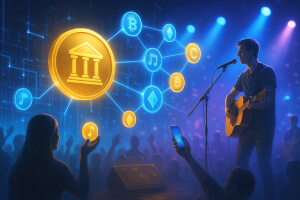
Central Bank Digital Currencies, or CBDCs, are emerging as digital forms of money. Unlike cryptocurrencies that run on a blockchain and are decentralized, CBDCs would provide stability, regulatory backing, and legal recognition. So, they could be used in the music industry as a trusted platform for money transfers, ticketing, merchandise buying, and subscriptions.
CBDCs act as the bridge between traditional finance and DLT ecosystems. They can coexist with decentralized tokens, giving artists and platforms a reliable channel through which to conduct day-to-day transactions while keeping the innovation flowing in tokenized assets and smart contracts.
Streamlining International Payments
International payments relating to music rights, royalties, and licenses involve delays and heavy charges. CBDCs may solve these problems and be transacted almost instantaneously across borders by their nature. On the other hand, coupling CBDCs and blockchain record-keeping ensures that the paying and receiving of funds by artists and collaborators are done in a cashless manner above board across the global music industry.
Hybrid Payment Models
Hybrid systems combining CBDCs and cryptocurrencies allow the music industry to benefit from both stability and innovation. Artists can use CBDCs for predictable income streams while employing decentralized tokens for unique projects, fan engagement, and fundraising. It is this interplay of security, compliance, and flexibility that would catalyze the widespread adoption of solutions throughout the industry.
Blockchain, AI, and the Digital Music Ecosystem
The intersection of blockchain with artificial intelligence, gaming, and digital entertainment is gradually enriching the existing music ecosystem. AI means that royalties can be optimized, trends can be predicted, and real-time copyright infringement can be detected, while blockchain fosters an environment of transparency and trust.
Through tokenized assets, gaming and virtual worlds integrate music. This means that fans may buy, sell, and trade digital tracks, virtual tickets for concerts, or in-game items tied to an artist, thus having real ownership of music-related experiences. This link provides revenue to musicians and evolves the way in which audiences can interact with music.
AI for Music Analytics
The AI can analyze streaming data, fan behavior, and the market trends to maximize marketing and monetization activities. The linkage of AI-generated insights with the immutable records of blockchain allows royalty calculation and anomaly detection to be completely automated and, likewise, recommendations to be more personalization-oriented for fans. Under this amalgam, musicians benefit from data-driven decision-making without compromising their fair compensation.
NFTs and Digital Collectibles
There are many different ways in which the rise of NFTs has ushered in a new frontier for music engagement. NFTs can be limited edition releases, concert access passes, or collectible art. Thus, patrons would actually have a certificate of ownership, while artists could sell unique experiences that were almost impossible to sell via traditional means. Since digital assets are tokenized, there are secondary market sales, which generate a long-term income stream for the creators.
Security and Regulatory Considerations
With cryptocurrency entering the gates of the music industry, security and compliance issues become a top-most priority. Users have to secure the private keys, verify the authenticity of those digital assets, and choose good platforms. While blockchain is secure by design, however, human errors or platform-level vulnerabilities might lead to great losses.
With the changes in regulations, consumers are protected while innovation is promoted. Depending on their jurisdictions, certain music-related applications, such as tokenized royalties or ticketing by NFT, have to navigate complex legal terrains. In the long term, those able to maintain decentralization and transparency while meeting the regulation standards would be those who would succeed.
Protecting Artists and Fans
Security shall serve to safeguard the intellectual property rights of artists, thus affording the protection of the fans in the acquisition of digital assets. Multi-signature wallets, hardware wallets, and smart contracts provide the means of minimizing unauthorized transactions, which are further reduced by blockchain records, which are eternal and include both ownership and use.
Regulatory Alignment
Clear regulations help, of course, for the music industry, not to mention the cryptocurrency ecosystem in general. Countries that have well-defined frameworks for digital assets attract investment, innovation, and institutional participation. Upon their right legal footing, artists and platforms can thus confidently explore tokenization, NFTs, and payments via cryptocurrencies.
The Next Era of Decentralized Music Platforms

The rise of decentralized music platforms is set to redefine how content is shared, monetized, and consumed. These platforms remove the traditional gatekeepers, allowing artists to interact directly with fans while retaining control over pricing, distribution, and rights management. Unlike conventional services, decentralized platforms use blockchain technology to ensure transparent transactions, immutable records of ownership, and fair compensation for creators.
Fans benefit from this new model as well. They can support artists through tokenized contributions, gain exclusive access to content, and even participate in decision-making processes for releases or live events. This shift promotes a more collaborative and financially inclusive ecosystem, where artists and audiences share mutual incentives for success.
Future Full of Change
Cryptocurrency changes the music industry by putting tools behind transparency, faster payments, and more engaged fans. Smart contracts, rights tokenization, AI analytics, and hybrid payment systems help foster an ecosystem in which artists are empowered while fans actively participate and platforms work securely and efficiently.
The new world of music will include digital and decentralized aspects but will also be very practical and inclusive. Stablecoins and CBDCs provide dependable means for daily transactions; conversely, decentralized tokens and NFTs foster creativity, give investment options, and further the interaction with the audience. By embracing these newest technologies, the library of tunes can move beyond age-old hurdles, drought the chafe and inefficiencies, and bring equity and sustainability into the creative economy.
Quick Links
Why do you think cryptocurrencies are declining? If so, which coins will lead to a rise? pic.twitter.com/hDK1paC7KT
— Pix Animal (@PixAnimalNFT) November 2, 2025
With the kind help from

#CryptoCorner | A growing number of U.S. banks are embracing cryptocurrencies JPMorgan to allow institutional clients to use crypto as loan collateral Goldman, BNY partner to launch tokensied money Morgan Stanley's retail clients can trade Bitcoin, Ethereun, Solana by Q2 2026… pic.twitter.com/jyslWKOKSz
— CNBC-TV18 (@CNBCTV18News) October 27, 2025