The music industry has long dealt with the slow payment of royalty fees, with payments that lack transparency and intermediaries asserting their undue share of the proceeds. The second-largest blockchain in the world, Ethereum, offers a solution for this: smart contracts, dApps, and tokenized assets. Its programmable nature allows a smart contract to automatically do licensing, royalty payments, and distributions, providing artists with more control over their work. Equally important, with instant royalties paid, fan engagement through NFTs, and effortless transactions, Ethereum sets the canvas for an equitable, innovative, and rightful strong connection between creators and their audiences.
How Ethereum Works
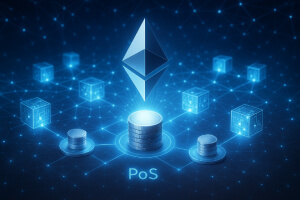
Ethereum exists on top of a decentralized network of nodes, which store a truly immutable record of transactions and smart contract executions. Transactions are piled up into blocks and linked in chronological order, after performing checks for things such as double-spending and fraud. Earlier iterations of Ethereum worked on a proof-of-work consensus system, much like Bitcoin, which required computational power to be wasted and that would validate transactions and secure the network. The proof-of-work concept, while very good, has some drawbacks: majorly, since it requires an incredible amount of electricity, it cannot be high throughput in usage, say, for music royalties or an NFT marketplace.
Ethereum shifted to proof-of-stake through The Merge in 2022. In proof-of-stake, validators lock a certain amount of cryptos to reach consensus, instead of solving computationally-intensive puzzles. This transition significantly Natureful energy diminution of the Ethereum tradition in checking the qualities of security and decentralization. It is worthy for the music industry because the PoS can revert microtransaction payments from almost-Ant-Era-NFT minting-and-smart contract executions considered never truly viable due to high fees-for-file-smaller creators.
Smart Contracts in the Music Industry
The whole production and monetization of music has been changed by smart contracts. Previously, artists would depend on record labels or collection agencies to track sales and pay royalties. These are slow, diactic, and an error-prone appraisal. Setting the terms beforehand, smart contracts on Ethereum allow creators to be paid royalties automatically: every time a track is streamed, bought, or licensed, the contract automatically pays the stakeholders. Such automation maximizes the flow of payments into transparency, which will also reduce fighting amongst artists, producers, and collaborators.
Additionally, smart contracts provide very fine-grained revenue distribution. Suppose a song has three co-creators: each would be able to automatically receive their exact shares whenever any income might be generated. This system removes manual reporting and reconciliation and is further fair. Ethereum contracts will also allow platforms to set up conditional payments: for example, payments may be triggered once a track earns a number of streams, or if an NFT gets resold on the secondary market. In that respect, smart contracts bring in an element of exact enforcement and high degree of immutability, as the terms are encoded directly on the blockchain.
NFTs and Music Ownership

One of the greatest avenues that have celebrated music on an Ethereum canvas had to be NFTs. NFTs stand for unique digital entities registered on the blockchain; they could represent a song, an album, or a concert ticket, even an exclusive-fan experience. So it opens a window for making money from creativity for musicians aside from streaming revenues and physical sales. Tokenization of music will help the artists sell merchandise limited editions of music, backstage passes, or collectible experiences for fans.
On Ethereum's NFT standards, including ERC-721 and ERC-1155, owning something comes with being able to prove it to anyone else out there. This power leaves some stake in the artist's hands, even on secondary markets. Resale might be the generating royalties on NFT for the very first creator, making the artist's possibility of generating revenue forever-a Cooperative never possible in the Convention music business. Artists like Kings of Leon, Grimes, and 3LAU have sold albums and rare digital collectibles directly to their fans via NFTs, cutting out all the middlemen and thus broadening engagement.
NFTs also bring a great leverage for fan engagement. Fans can hold ownership in a song, vote on certain creative decisions, or get access to exclusive content. Such gamification fosters community loyalty and further create incentives for economically rewarding participation. The transparent ledger of Ethereum makes transactions secure, traceable, and enforceable. This convinces and builds an initial level of trust between artists and their audiences.
DeFi for Musicians
These are some of the numerous opportunities for musicians to develop projects, manage income, and attract investment to their systems in the new economics of DeFi. An artist can mortgage future royalties, issue tokens representing shares in an album, or even fundraise for various projects on decentralized lending platforms. Ethereum disables traditional financiers, allowing the artist to retain ownership of the work and tap into an international pool of support and investment.
DeFi furthers the experience of active engagement of the audience in a financial ecosystem of an artist. The fans stake tokens to earn some kind of reward, whether that be having some creative input or VIP passes to an exclusive concert. Hence, that kind of engagement converts an artist's investment for mutual benefit between both the artist and the audience. DeFi marketplaces on the Ethereum blockchain, therefore, build a layer of transparency and trustlessness, where revenue and voting rights are handled by automatic smart contracts, thus reducing any probable conflict or interference.
DeFi instruments on Ethereum could prove to be beneficial for the sustenance of artists. For instance, working together by pooling their assets could be applied within musicians to finance working projects of some kind, nurture new talent, or form decentralized record companies. In this way, these models give the administration and documentation side of music in the hands of producers; smart contracts then share risk and revenue as a counter to the establishment of other types and geographies.
Role of Ethereum in Music Distribution
In the conventional model of music distribution, the streaming services or any other intermediary would take control of the process. Streaming platforms tend to hide the data while the payments may take a long while to come in. The notion of decentralized music platforms is brought in by Ethereum-based programs wherein tracks are hosted on multiple nodes with access being governed through the mechanisms of smart contracts. This, in turn, allows for artists to upload music, specify their license terms, and finally get paid directly from the fans, meaning they get a larger share of the revenues.
There is another bit of transparency added by decentralized distribution. Whenever plays, downloads, transfers, or the like occur with artists' content, the appropriate data is entered onto the blockchain.
Ethereum lets artists control the economic and creative processes of their works. It lessens the chances of piracy while assuring that the industry revenue ends up being transferred from buyer to seller, thus preserving the integrity of the music industry.
Ethereum and Live Music Scenes
Ethereum gives forth the idea of tokenized ticketing and event control over live music. Smart contracts can issue ETS or digital tickets that also verify onto the blockchain, thereby reducing instances of fraud, including buying and selling for illegal gains, or scalping. Such NFT tickets can carry bonuses like backstage passes, collector's memorabilia, or perhaps exclusive after-country-level content for holders of a limited edition.
Live shows in Ethereum may accommodate some degree of fan participation wherein holders of certain NFTs get to vote on setlists, give their say on whichever encore is performed, or simply be prioritized for access to meet and-greets. Thereby creating an on-chain live music experience: in effect, Ethereum fosters immersive, engaging, and financially transparent events, laying out a win-win scenario for both artists and audiences.
Scalability and Layer-2 Solutions

Ethereum has been struggling with scalability, especially when the demand hits high levels. Network congestion can hike up transaction fees or gas costs and slow down processing time; hence such delays could impede their adoption for heavy-volume music platforms or NFT marketplaces. Theoretical proposals exist of a layer-two ecosystem that carries out transactions off-chain while subjecting security and finality guarantees to the Ethereum main chain, whether they be rollups, side-chains, or state channels.
Layer two solutions keep Ethereum workable for everyday use in the music industry. Artists can do microtransactions, sell thousands of NFTs, or distribute streaming royalties with almost zero fees. These scalability enhancements stand to support real-time apps such as fan voting, collaboration projects, and interactive music experiences, thereby setting the stage for massive adoption within the creative association.
Regulatory Aspects in Music Blockchain
Given that the Ethereum blockchain presents transparency with a sort of automatic control induced by law-based institution-less avenues, lawyers could go on and state lawfulness as a matter for concern. Neighboring considerations are copyright laws, intellectual property rights, licensing agreements, and tax implications, all in relation to blockchain-based systems. Musicians and platform operators who wish to work with Ethereum under these separate legal regimes to avert conflicts would want the selling of NFTs, royalty distributions, and tokenized assets all to abide fully by their respective Governments.
Cross-Platform Integration and Interoperability
As the blockchain ecosystem grows, Ethereum’s music applications are no longer confined to a single platform. Interoperability allows smart contracts, NFTs, and DeFi tools to function across multiple marketplaces, wallets, and music platforms, giving artists broader access to fans and investors. This cross-platform functionality ensures that an NFT or royalty token purchased on one service retains its value and enforceability elsewhere, increasing liquidity and engagement opportunities.
Moreover, interoperability facilitates collaborative projects where multiple platforms can contribute to revenue sharing, fan experiences, and live events. Artists can leverage different communities and tools without being locked into a single ecosystem, enabling a more flexible, resilient, and scalable model for music distribution and monetization. This capability also encourages innovation, as developers can create new applications and experiences that seamlessly interact with existing Ethereum-based systems.
Ethereum Changes the Music Game
The music scene is riotously disrupted and merged with creativity by technology: through smart contracts, DApps, NFTs, and DeFi systems, artists have got back control of their creations to guarantee fair payment and entertain the audience in newer ways. With Ethereum passed into proof-of-stake with scalability improvements and programmable blockchain logic, the platform can be ventured into for building some real-world applications. For musicians, fans, and platforms, Ethereum is much more than a technical tool; it is a framework for transparency, collaboration, and financial empowerment, forming into the future of music in a decentralized digital world.
Quick Links
Why do you think cryptocurrencies are declining? If so, which coins will lead to a rise? pic.twitter.com/hDK1paC7KT
— Pix Animal (@PixAnimalNFT) November 2, 2025
With the kind help from

#CryptoCorner | A growing number of U.S. banks are embracing cryptocurrencies JPMorgan to allow institutional clients to use crypto as loan collateral Goldman, BNY partner to launch tokensied money Morgan Stanley's retail clients can trade Bitcoin, Ethereun, Solana by Q2 2026… pic.twitter.com/jyslWKOKSz
— CNBC-TV18 (@CNBCTV18News) October 27, 2025